This article was originally published in January 2020 and is a part of my Master’s thesis for my degree in Public Policy.
Does Europe really think that Fake news is a problem? This data set from the Eurobarometer helps us understand this in greater depth.
Introduction
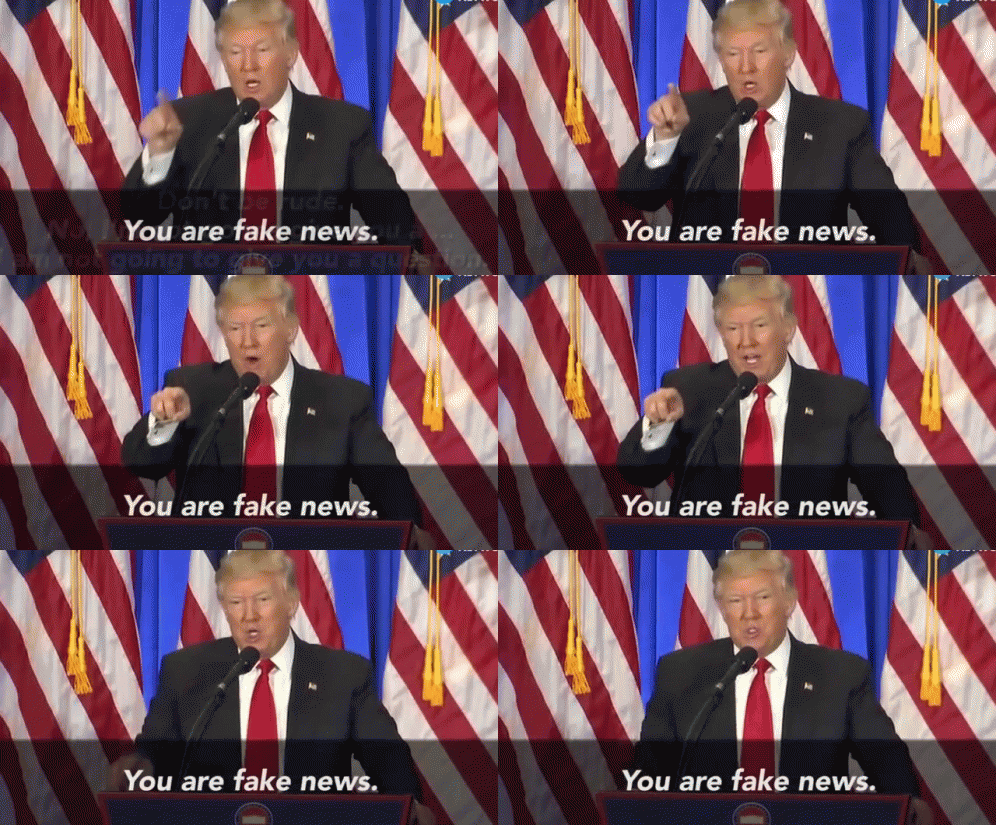
Fake news has been the buzzword in all media circles, since the election of Donald Trump. His insistence on referring to legitimate news sources and events as so has given previously nonexistent notoriety to the words Fake News. Often polarizing in reception, Fake News has been received with adulation and condemnation in equal measure, from both sides of the political number line. If anything, the only issue that activists from both sides would agree on, is that the conversation around Fake News needs to be increased, structured, and legitimized. We are all familiar with the effect that fake news has had in the US, but how is it in Europe? The biggest casualty of this frenzy has been the United Kingdom, with its Brexit vote.
As defined by the Cambridge Dictionary, Fake news is nothing but false stories that appear to be news, spread on the internet of using other media, usually created to influence political opinion or sometimes as a joke. In a paper published in the journal Science Advances, it has been found that Conservatives and people above the age of 65 have a higher likelihood of believing in fake news.

Figure: Ideology vs Number of Fake News Articles Shared
Research has shown that those who consider themselves to be more conservative, share more instances of Fake News than others. It also shows that Democrats are less likely to share Fake News than Republicans

The political leanings of Democrats and Republicans can be better understood by looking at the research of a famous 20th Century Political Scientist, Hans Eysenck.
The Political Spectrum — Eysenck
Hans Eysenck in his research of political attitudes in Great Britain and Europe. He noticed how there was an eerie similarity between those on the Far left (communists) and those on the far right (Nazis), when he studied the regions of the USSR and Germany during the 1940s and 1950s. The final product of his research was the diagram of the political spectrum that he had used to classify political attitudes, as left and right, authoritarian or democratic, and so on.

Fig: Political Spectrum — Eysenck
Therefore, those citizens who identify themselves on the right side of this spectrum, have been shown by the aforementioned study to have an increased inclination towards sharing Fake News, and not perceiving at as a large problem. While all this research is elaborate, it is focused heavily on the United States of America. In this research paper, we will try and make an attempt to understand and analyze this further, by examining the attitudes that the citizens of the EU have, towards Fake News, using various independent variables.
Data used for the paper
For this paper, I had the chance to utilize an extensive Micro-level data set that was created after extensive research, conducted by the European Commission. The dataset was obtained from the website of the GESIS. The survey was titled Fake News and Disinformation Online and was conducted in all 28 EU member nations. At the time at which this survey was conducted (Feb 2018), the United Kingdom remained an integral part of the EU and hence has been treated duly, in this survey and consequently in this paper. The data was collected through telephonic interviews across all member states, and all participants were aged 15 years or more. The Master Questionnaire was translated into several languages as per the primary language of the member state. Besides the questions with an intent to help with the classification of participants (age, gender, education, etc.), the questions that sought to understand perceptions of Fake News and Disinformation, had responses on a Likert scale. The original data set had a total of 26576 observations, with recorded responses for over 202 variables.
Besides the data that was used from the GESIS research, I decided to utilize the results/output of another data set that helped to answer a question I had. Since research has shown that in the United States, citizens with conservative opinions hold less anathema towards Fake News, would the same sentiment be reflected across the continent of Europe? With the culture of the continent enforcing more discreet behavior, it is often difficult to ask and identify the political opinion of strangers. Hence, I had the chance of using the results of research conducted by a leading German newspaper, Die Zeit.

Fig: Die Zeit’s classification of Europe based on Ideology
The newspaper managed to analyze the vote share of all 28 EU member states leading up to the European Parliamentary elections that were held in May 2019. By using the strongest category in the last national elections, the EU countries were marked according to the possible dominant political ideology. With the help of this data, and looking at Eysneck’s political spectrum, I classified the 28 EU member nations into 4 categories, namely,
Far Left Countries
— Greece, Sweden, Romania, Spain, Malta, and Slovakia.
Liberal Countries
— Finland, Lithuania, France, Netherlands, Denmark, Belgium, and the Czech Republic.
Conservative Countries
— Bulgaria, Ireland, UK, Portugal, Germany, Austria, Hungary, Cyprus, Croatia, Luxembourg, and Slovenia.
Far-Right Countries
— Estonia, Latvia, Poland, and Italy.
Therefore, a small (but thoroughly backed by data) leap of faith to understand the political opinions of individuals through this data set has been taken.
Formulated Hypotheses
The existing research has clearly shown the effect of age and political leaning, on one’s attitude towards fake news. I would like to verify this hypothesis in the European Context, and with the help of the supplementary results from Die Zeit, I would like to see the effect of region on attitudes towards fake news. Therefore, I would like to make 4 hypotheses; namely
1. Far Left Countries will believe strongest that Fake News is a problem and as we go right, the belief would be less strong.
2. The older generation will have a higher likelihood to discredit Fake News as a real problem.
3. Education Levels could alter attitudes towards Fake News, with those who are highly educated, more in agreement that Fake News is a problem.
4. Frequent Use of Social Media could lead to a lack of belief in Fake News as a problem due to desensitization towards the same.
The Dependent Variable
Out of the questions that were asked, the ones that did not have a primary intent to classify and sort data were marked with the letter ‘Q’. For this paper, I have focused on Q4 of the master data set. On reading the survey, the exact words of Q4 and its responses, are as follows.
Q4: In your opinion, is the existence of news or information that misrepresent reality or is even false, considered a problem?
1. Yes, Definitely a problem.
2. Yes, to some extent it is a problem.
3. No, not really a problem.
4. No, definitely not a problem.
5. Did not Answer
With the answer to this, we can best understand the attitudes towards Fake News that individuals have, across the continent. To get a preliminary understanding of the responses towards the dependent variable, we have a cross table that shows the share of total responses towards the dependent variable, classified into 2 categories. Responses 1 and 2 for the question, have been coded as “1 — Yes, Fake News is a problem”, and responses 3 and 4 have been coded as “0 — Fake News is not a problem”. Let us now look at the share of the number of people and their attitudes towards fake news, as classified based on these 4 categories.

Fig: Classification of Countries based on responses to the Dependent Variable.
There are only 11294 observations in total in the final data set that I had to choose to analyze. This was filtered to include participants between the ages of 18–100, remove the missing observations for those who did not wish to respond to age, gender, etc. Furthermore, only those participants with access to an electronic device to access news and the internet, were considered to be a part of the data set. As most fake news is circulated online, it did not make sense for this particular research question to see include those who do not have the means to access the internet.
Much to our surprise, we can notice that an overwhelming majority of people, nearly 82.504% of all citizens of Europe, irrespective of the country they come from believing that Fake News is indeed a problem. This must be met with a feeling of relief at the outset, as it shows that most of the EU have not fallen victim to Fake News. Whilst ideals that are anachronistic to the 21st century, such as homophobia, anti-abortion laws etc. are resurfacing on the grounds of religious renaissance, the tragedy of Fake News continues to remain in the doldrums in the continent of Europe.
We will now seek to create a visualization of the same across the four countries, with the help of a bar graph. It is indeed refreshing to see the same trend on the graph, that an overwhelming majority of people in Europe, irrespective of the region that they come from consider Fake News to be a problem.

The Independent Variables
To better understand the responses to fake news from the citizens, I consider other independent variables and seek to measure their effect on the dependent variable.
Age
Since existing research has shown that Elder citizens are more likely to believe in fake news, I believe that more senior citizens will consider Fake News to not be a problem. Therefore to measure the effect of age on the attitude towards Fake News becomes necessary.
Gender
Studies have shown that political activity has always been higher among men, compared to women. Hence it will be interesting to measure the effect of Gender on attitude towards Fake News, as those who are not politically active may not have strong opinions on Fake News.
Frequency of Social Media use
Most Fake News that is found in the media, is on social media. The traditional forms of media, such as print, radio, and television often are bound by the law and have provisions against defamation, libel, etc. The internet, on the other hand, circumvents such legal courtesies that are essential to maintain a democracy, with the help of anonymity. Hence, this platform has become the source for all Fake News. Therefore, to measure the effectiveness of the frequency of social media use on attitudes towards Fake News becomes essential.
Level of Education
Education is an important independent variable that controls one’s attitude. In this case, we can hypothesize that those who are of higher education will have a lesser inclination towards believing in fake news. In the dataset, there was no clear variable to determine the level of education of an individual, hence I had resorted to using another variable that classifies participants based on their occupation. With this, I grouped those with low skill occupational jobs such as industry worker, farmer, shop keeper, etc. as having a low level of education, whilst those who were in management, bureaucracy, government, professionals such as lawyers, doctors, teachers, etc. were considered as people with high levels of education. Hence, the effect of education on attitudes towards Fake News needs to be measured.
Region
After classifying the continent of Europe into 4 regions from the beginning, the effect of coming from a conservative or liberal, or FR/FL country, could have an effect on one’s attitudes towards Fake News. Since most conservatives are having an inclination towards accepting and spreading Fake News, we could expect similar behavior in Conservative and Far-Right countries, compared to their counterparts on the left-hand side of the political number line.
Interpretations of Results
As we are interpreting the results which are in odds and odds ratios we begin by assigning reference categories for all independent variables that are categorical in itself. For the variable concerning the region, Far Left Countries is the reference category. Age has Young participants as reference. The frequency has users who do use a lot of social media as reference. The level of education takes those who have a high level of education as a reference, and finally Women are the reference category for the independent variable of Gender.

Model 1 —
Regression of the Dependent variable on 3 independent variables, Age, Education, and Gender.
In the first model, we limit our regression analysis to 3 independent variables to see the outcome. As we are interpreting odds ratios, we notice that for the variable of age, those who are Old Aged are less likely to agree that Fake News is a problem. The odds that a senior citizen views Fake News as a problem, drop by 14.3% compared to the younger generation. This verifies previous research done on this topic that those who are above 65 years of age have a higher inclination to share fake news and the same can be seen here. Old Aged participants in this paper are those above the age of 60. A middle-aged participant, between the ages of 40 and 60, has a higher likelihood of agreeing to the notion that Fake News is a problem compared to the reference category, and the odds of the same are 32.6%. For the independent variable of Education, we notice that participants who are not very highly educated, have a less likelihood of believing that Fake News is a problem. The odds of which 49% lower, compared to someone who is highly educated. Hence we can find support for the hypothesis that the higher the education level of a citizen, the lower his/her chances of believing in Fake News.
We notice that Age and Education are significant at the 99.9% level in this model and therefore the hypothesis formulated based on education and age can be reaffirmed. The Gender variable shows that men have a 2.4% higher odds of thinking that Fake News is a problem than men. The fact that it is not significant is a reason to believe that the role of Gender in attitudes towards Fake News is very minimal.

Model 2
Adding the Variable of Social Media use to existing variables in Model 1.
It is essential to consider the social media use of a participant in this case, as more often than not, Fake News is primarily circulated on Social Media channels. Hence, when we include that variable in the 2nd model, we notice that the user who does not use social media very often has a less likelihood of believing that Social Media is a problem. The odds of an infrequent user of social media to believe that Fake News is a problem is 33.3% less in comparison to a frequent user of social media.
Furthermore, we must note that on including frequency as an independent variable, middle-aged participants are no longer significant. Also, it is pertinent to note that the fall in the odds ratio for the Middle-Aged variable on the inclusion of Frequency, from 32.6% to 8.8%.
Therefore, an inference could be made that as the Youth and Middle-Aged participants use social media channels more frequently than old aged participants, there is considerable interaction between social media use and age.

Model 3
Controlling for Region, along with existing variables of Model 2.
We are including the effect of Region in this model. With the help of the outcome of the survey conducted by Die Zeit Newspaper, I had classified the member states of Europe into 4 categories, based on Eysenck’s political spectrum. I believe that the environment from which a participant is, could have a determining role in one’s political attitudes.
A surprising trend noticed here is that the likelihood of a country, irrespective of where it lies in the political spectrum, believes that Fake News is a problem. This helps support the initial cross table, where we noticed that 82.5% of all respondents considered that Fake News was indeed a problem.
The odds that a Far-Right country would believe that Fake News is a problem is at 31.9%. The odds that a Conservative Country would believe that Fake News is a problem is at 62.1% and the same for a Liberal-Country is 94.6%, taking the Far Left countries as reference.
The effect of other variables such as Age, Educ, and Frequency of Social media use, remain significant as in the previous model, and the odds of the same do not differ drastically. The regions are also significant in their effect on the dependent variable, in the 99.9% region.
Conclusions
First I would like to briefly visit the 3 hypotheses that I had made, at the beginning of this paper. The first hypothesis was that Far Left Countries will believe strongest that Fake News is a problem and this would reduce as we go towards the right of the political spectrum. This hypothesis stands partially supported. Far Left countries being the one that is most in opposition to Fake News isn’t verified, as it is the Liberal Countries who have shown the highest odds of being opposed to Fake News. But the fact that as we go towards the right, Looking at Conservative Countries and then the Far-right, we notice that the odds of the country having attitudes which feel that Fake News is a problem, reduces, by 32% from Liberal to Conservative, and 31% from Conservative to Far-right. The reason I say the hypothesis is only partially supported is that I had expected conservative and far-right countries to think that Fake News is not a problem worth considering, but that hasn’t happened. This is a pleasant surprise indeed.
The second hypothesis, that the older generation will have a higher likelihood to discredit Fake News as a problem, is supported. We have noticed in all 3 models, how those from the old age group of above 60 years of age, have fewer odds in relation to the dependent variable and therefore have a less likelihood of actually believing that Fake News is a problem.
The third hypothesis on Education is supported, as across three models it is shown that those with Higher education have an unfavorable attitude towards Fake News. We can see from across all 3 models, that those with Lower Education have a less likelihood, and lower odds, to believe that Fake News is a problem.
The last hypothesis, being that high use of social media would desensitize an individual towards Fake News, is not supported by either of Model 2 or Model 3 It shows that those who do not use social media very often, have a less likelihood and consequently lower odds of believing that Fake News is a problem. Therefore, we can hypothesize that regular users of social media, who are exposed to a higher amount of Fake News content than those who don’t, are not desensitized, but rather increasingly aware of their predicament and consequently more vigilant in interacting with the internet.
Policy Recommendations
Fake news is the most preferred weapon of modern digital warfare. This is because Fake News seeks to change information and as a consequence perceptions/attitudes that people may hold towards certain issues of importance. By wrongly spreading the information that the UK sends 350 Million GBP every week to the EU, it was enough to create resentment against the institution and push the country towards a historic referendum. Furthermore, with foreign powers interfering in the elections of other states for personal benefit, it is essential that as policymakers we must consider this a grave problem and act accordingly. Certain steps that government can take to curb this menace of Fake News is as follows:
Media Literacy Handbook
Most Scandinavian countries, with Sweden and Denmark taking the lead, have come up with campaigns for the public that help them identify Fake News by looking for tell-tale signs. Furthermore, citizens are asked to use good practices in consuming news, by relying on reputed sources, verifying news from multiple channels and always refraining from spreading any misinformation. Media outlets have also increased scrutiny and are expected to publish information that is thoroughly backed by facts/research, so as to not dupe its readers into believing falsehoods.
Government Task Force & Government Legislations
Most western governments have begun creating laws and setting up Task forces with varying degrees of success. The task force is seeking to work with Information and IT ministries about regulating content online. Some governments have been more aggressive in the fight against disinformation, for example, Germany’s “Netzwerkdurchsetzungsgesetz” that forces Social Media sites to remove obviously illegal content off the internet or face enormous fines, and this law has been met with mediocre success. During elections, the Canadian government will seek to create an independent body with a mandate to verify news reports. Social Media companies such as Facebook have taken the onus on themselves and begun working to combat Fake News. The 40 person war room in Dublin by Facebook during the EU elections in 2019 to combat Fake News, shows that there is increased attention being given to Fake News and the problems it could cause.
It is indeed a relief to see that compared to the US, the attitude towards Fake News is different. It is still viewed as a big problem across the 28 nations comprising the EU and with increased activity from governments, hopefully, this will continue to be tackled in the years to come.
— — — — — — —
References
– Definition of Fake News from the Cambridge Dictionary.
https://dictionary.cambridge.org/dictionary/english/fake-news
– Less than you think: Prevalence and predictors of fake news dissemination on Facebook
BY ANDREW GUESS, JONATHAN NAGLER, JOSHUA TUCKER
SCIENCE ADVANCES09 JAN 2019: EAAU4586
– European Commission, Brussels (2018): Flash Eurobarometer 464 (Fake News and Disinformation Online). TNS opinion, Brussels [producer]. GESIS Data Archive, Cologne. ZA6934 Data file Version 1.0.0, DOI:10.4232/1.13019
– From the Left to the Right — Classification of EU countries based on previous voting trends.
https://www.zeit.de/politik/ausland/2019-05/elections-in-europe-eu-countries-results-map-english
– Hans Eysenck’s definition of Political Spectrum
https://www.wikiwand.com/en/Political_spectrum
– The inclination of Republicans to share fake news, compared to Democrats.
https://www.theatlantic.com/ideas/archive/2019/06/fake-news-republicans-democrats/591211/
– Americans agree that misinformation is a problem that needs to be tackled.
https://www.journalism.org/2019/06/05/many-americans-say-made-up-news-is-a-critical-problem-that-needs-to-be-fixed/
– The inclination of Old people to share more fake news.
https://www.straitstimes.com/world/united-states/older-people-conservatives-more-likely-to-share-fake-news-study
– Conservatives are more susceptible to Fake News than Liberals
https://medium.com/@chrismartin76/no-liberals-and-conservatives-arent-both-susceptible-to-fake-news-ed7e22429aad
– Liberals and Conservatives’ opinion on Fake News with regard to Brexit.
https://www.bps.org.uk/news-and-policy/liberals-and-conservatives-cry-“fake-news”-different-reasons