
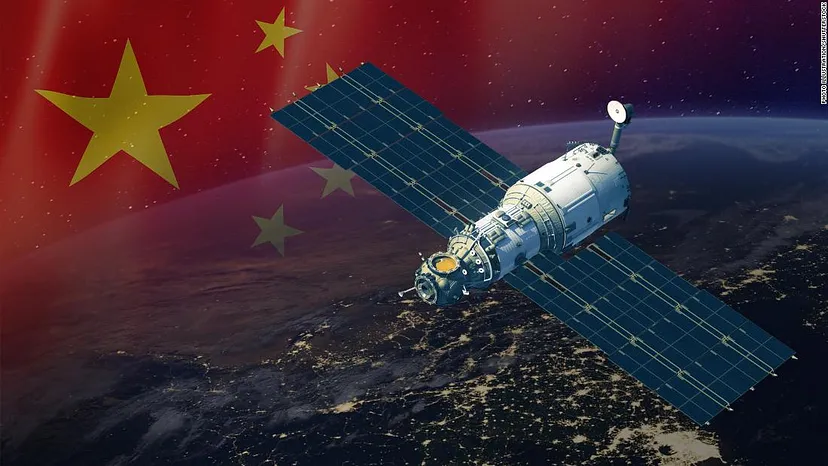
Space, matters. The Chinese have realized
this better than the rest
Originally published in July 2019 here.
With the launch of Sputnik 1 in 1957, the Space race was declared open. The US and the USSR, the 2 great powers of the 20th century engaged in a race to better one another and the world tremendously benefited from this battle. Every time an ego was bruised, more funds poured into Research and Development in order to produce the pinnacle of Space technology, especially one that wasn’t matched by the other. The unintended consequences of the Space race were innovative products that made our daily lives better, such as artificial limbs, water purifiers, satellite TV, and frozen food. While the Space race was a blessing in disguise, its exponential growth had to be curtailed by ethical boundaries.
‘Every time an ego was bruised, more funds
poured into Research and Development’
International Law governing Space and celestial bodies gained importance. The first law that was created was the “Outer Space Treaty” (OST) in 1967 — that focused on the principles governing the activities of member states in the exploration/use of Space and celestial bodies. The treaty ensured that Space was always open to peaceful exploration to all parties and no single state could claim sovereignty over it. Furthermore, the treaty clearly states that no member state must station any nuclear or weapons of mass destruction, in outer space or on celestial bodies. The “Space Rivalry” officially ended in 1975 with the first Apollo — Soyuz joint-test mission, but the Space race had only taken a back seat.
The seed of the modern-day Space race was first sown in 2002, when Ouyang Ziyuan, chief scientist of China’s lunar exploration program said: “The moon could serve as a new and tremendous supplier of energy and resources for human beings, and whosoever conquers the moon first, will benefit tremendously”. 5 years later, in 2007, China would take the first step towards achieving this goal. Unlike Apollo, NASA’s Space project named after the Greek god, China’s Lunar Exploration Program (CLEP) was named after a mythical figure in Chinese mythology, Chang’e. Chang’e was a Chinese goddess of the moon who, as legend has it, made the moon her home.
‘CLEP clearly stating that China aims to establish
a permanent base on the moon by 2036′
On the 3rd of January 2019, China became the first nation to land a satellite, the 4th edition of its satellite, the Chang’e 4 on the far side of the moon. Chinese intentions have now been made very clear, with the CLEP clearly stating that China aims to establish a permanent base on the moon by 2036. China is sending 2 lunar probes before the end of the year to determine the existence of water-ice and other resources on the moon. The reaction from the erstwhile pioneer of lunar landings, the United States, shows nervousness.
“It is the stated policy of this administration and the United States of America to return American astronauts to the moon, within the next five years,” said the Vice President of the United States, Mike Pence in a speech in March 2019. NASA also seeks to establish its own moon base by 2028, named Artemis, who in Greek mythology, is the twin sister of Apollo.
In spite of having its own lunar mission, the United States still views China, and to a certain extent Russia, as aggressors in Space. At this juncture, it becomes crucial to point out one of the many loopholes present in the OST that has been exploited by nations all over the world. While the ban on the weaponization of Space continues to be accepted universally, parties do not respond with the same condemnation regarding the militarization of Space. Utilizing Space for purposes of Command, Control, Communication, Computers, Intelligence, Surveillance, and Reconnaissance (C4ISR) is considered acceptable. These militarization techniques assist armies on the conventional battlefield, whereas weaponization would lead to Outer Space, emerging as a new battlefield in itself. To assuage American intentions, Chinese and Russian governments submitted an updated version of the OST, named ‘Placement of Weapons in Outer Space Treaty (PPWT)’ that states “A legally binding ban on placement of weapons in outer space as one of the most important instruments of strengthening global stability and equal/indivisible security for all.” Astute observers from the United States bemoan the fact that the revised PPWT, makes no mention of terrestrial-based anti-satellite weapons, which are a sizeable hindrance to the peaceful use of outer space.
“The infrastructure in Space is so entwined with our lives that it needs to be protected from all threats, even terrestrial”
“The infrastructure in Space is so entwined with our lives that it needs to be protected from all threats, even terrestrial”, said Mark Albrecht, former Executive Secretary of the National Space Council. He argues, “Military activity in space is therefore not different from when the U.S. Navy goes to distant waters not to cause war, but to make sure existing peace is ensured”. Albrecht fears that with the U.S. armed forces so heavily reliant on its communication satellites, i.e. the Global Positioning System (GPS), an attack on these satellites by Chinese forces, would leave them paralyzed. China has destroyed one of its own satellites with a terrestrial missile, resulting in millions of pieces of space debris, which could definitely cause irreversible damage to U.S. satellites.
Hence, it is established that there is a justifiable reason to worry if Space will be treated akin to the high seas — with no country claiming sovereignty and allowing for peaceful exploration of all interested parties. But the real question here is, are such efforts really worth it? What does a nation really stand to gain by reaching the moon? The answer is, an enormous amount of natural resources.
Scientists speculate that the moon is a great reserve of raw materials. The abundance of Helium-3 isotope gas, which has the potential to be the ideal non-polluting fuel for next-generation nuclear plants, interests every nation. Furthermore, lunar soil is rich in titanium, iron, and aluminum. With the natural resources of the earth dwindling at an exponential pace, lunar mining would become a necessity to ensure the continued survival of the human race. And in that necessity, lies an economic opportunity waiting to be reaped by nations and private players alike.
Other nations interested in Lunar Exploration are aiming for scientific discoveries through explorations. China is the only country that has a vivid long-term vision of creating human settlements on the moon and utilizing its natural resources. Chinese ambitions also include space mining, developing solar power stations, and making more modern military space institutions.
No other country has been able to match the long-term commitment to Space Exploration that China has. In 2013, Chinese President Xi Jinping spoke of the ‘Chinese Space Dream’ and how to make China stronger, it needs space technology. The United States has realized the same and is making efforts to make mining for lunar resources, a high priority. The establishment of NASA’s Swamp Works wing for deep space and lunar exploration is a testament to this.
The additional player in the mix is private firms. Entrepreneurs such as Jeff Bezos and Elon Musk have publicly spoken of long term space settlement goals, independent of U.S government influence. This creates problems of regulation, as private firms will seek to claim sovereignty over lands that they will occupy Outer Space and on celestial bodies, but as units of the nations they represent, it would result in a violation of the Outer Space Treaty. At the moment though, with China’s Chang’e 4 investigating the far side of the moon and with additional missions to follow this year, the country has established a considerable lunar presence whilst other nations are still in the planning phase. The outcome of this would be tremendous for the East Asian nation, whereas the United States would not take kindly to second place. China is laying the right kind of groundwork, by investing in technology that would safeguard its space assets even before it is built, much to the dismay of the western world. President Xi Jinping’s strategy of Civil-Military integration for Chinese growth that focuses on goals that help benefit the people of China and the nation’s defense capabilities simultaneously. Therefore to see the development of China, on planet earth and amongst the stars at the same time, is no longer a pipe dream. We are indeed approaching a point where ‘Star Wars’ is no longer just science fiction.