Originally published in August 2019 here.
Work as we know it has experienced 3 revolutions till date. Technical and technological progress is undoubtedly the impetus behind the changing outlook of work. It has been the case since time immemorial. Hunters and gatherers experienced an evolution in work when they had invented ancient weapons. The steam engine turned manual laborers and farmers into industrial workers, and today industrial workers are facing their biggest fears in the forms of robots and are dreading the digitization of the workplace. The unnoticed outcome of every revolution of work is the definition of skilled labor. In the early days of mankind, a skilled laborer was defined by his ability to use tools for his hunting and farming. The industrialized society, which we live in today, considers every individual that is part of the alphabetized class, to be skilled. With the advent of digitization, the society of tomorrow will no longer be able to afford those who are digitally illiterate. It will become the new yardstick to enter the labor market and be viewed as the minimum qualification to be considered as a skilled worker.
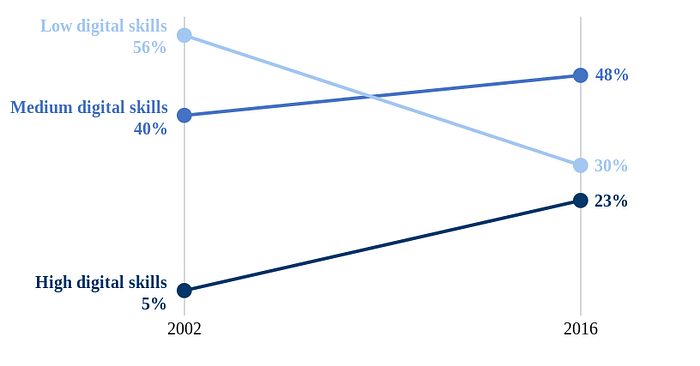
The above graph, shows the share of jobs in low, medium and high digital skill occupations, from 2002 and 2016. We can see that the need for digital skills in all levels, has seen a noticeable increase. This is a testament to the trend that the workplace of the future will undoubtedly require digital skills.
The biggest change one could notice with the modern workplace is the lack of a geographical constraint to get work done. Startups would be birthed at coffee shops and the employee would be in any corner of the world. An entire business model would merely consist of a laptop and an internet connection. With workers around the world, rigid working hours would become a thing of the past. Working from home/on the move would be quotidian. The example of truck drivers given in the previous article shows that it is not just jobs in IT that will be affected. Even those workplaces considered to be traditionally free from the influence of computers will see technology making a difference. This would create great flexibility for the employee to work according to his productivity and need, and the most important outcome of this would be more free time.

As we can see, fields that were traditionally considered to require a human touch, such as the profession of Lawyers, Auto Technicians, and nurses, are witnessing an increasing digital presence in it.
Dr. Rishipal, in his paper Analytical Comparisons of Flat and Vertical Organizational Structures, speaks about the digitized workplace of the future and its inevitable embrace of flat hierarchies. To put the employee in complete control of his or her own task. Hierarchies have survived all these years, due to this belief that ‘not everyone can be leaders’. This has created a feeling of alienation in the workers, from the end product. The digitized workplace of tomorrow gives every employee the responsibility, and more importantly, the opportunity to be a leader. With every employee accountable to no-one but his/her own self, this creates an “everyone is a CEO” mentality, and therefore encourages ownership of work. Also, when everyone is a boss, there cannot exist any hierarchy. A lack of hierarchy reduces the number of employees who work as managers, in comparison to those who are regular employees, this reduces the cost to the organization in hiring managers. Flat hierarchies utilize less office space and hence have reduced running costs. Furthermore, with lesser departments in the workplace with flat hierarchies, non-essential functions such as tax preparation are outsourced and with entire departments not present in workplaces, costs are reduced significantly.
Tomorrow’s digitized workspace also leaves a lesser strain on the environment, than conventional workplaces. Michael Dell, CEO of Dell Inc. In 2012, Dell launched its ‘2020 Legacy of Good’ and pledged to make 50 percent of its workforce remote by 2020. Research from the United States Environmental Protection Agency (EPA) shows the enormous gains to the environment by adopting a digitized workspace. The EPA finds that transport-related carbon emissions account for 69% of air pollution in America and this can be reduced tremendously by working from home. This also reduces the burden on fossil fuels that are required to run automobiles that are used to reach workplaces. Energy consumption at workplaces is twice as that of what is consumed at home. A study by Sun Microsystems, a subsidiary firm of Oracle, discovered that office energy use is nearly twice that of home energy use. By working from home, an employee can reduce a minimum of 5400 Kilowatt-hours of energy use, per year. With 24.7 million people in the American labor force, that would mean a 3.3% reduction in overall energy consumption, and therefore a significantly higher decrease in the carbon front, every year.
I would like to digress from stated facts and briefly present my opinion on why the workplace of tomorrow stands to benefit the average worker tremendously. A comparison with Universal Basic Income is made, and it could be classified as here say, nonetheless it could be good food for thought.
In my opinion, Universal Basic Income (UBI) could work against its raison d’etre. UBI is often seen as the solution to help people discover, what they really want to do. By providing a minimum amount of income for their sustenance, people are encouraged to find out their true passions and spend more time working on it, thereby making one’s work and passion, the same. The biggest enemy to this possibility is Parkinson’s Law. Cyril Northcote Parkinson, the famous British historian, and author, in 1955, said that “Work often expands to fill the time available for its completion”, hence UBI could be counterproductive as it gives an individual free reign over time to discover his/her passion. I believe that flexible work timings in this regard circumvent the pitfalls of this law. With such an advantage, an individual can choose when to work and therefore be at his/her best when working, consequently be more efficient at completing work given to him/her. This would not just ensure that a steady income is maintained, but improve the overall quality of living, by giving control of time back to the employee than the employer. With relatively limited time, an individual would often put twice the effort to enjoy/discover the things that one may enjoy. To paraphrase a millennial saying, happiness when playing hard, cannot exist before working hard.
Hence, the expectation of the digitized workplace is clear. Resistance to the workplace of tomorrow is emerging and our position on this needs to change. To effect change is considered to be extremely difficult, especially one that will create an ephemeral surge in unemployment.